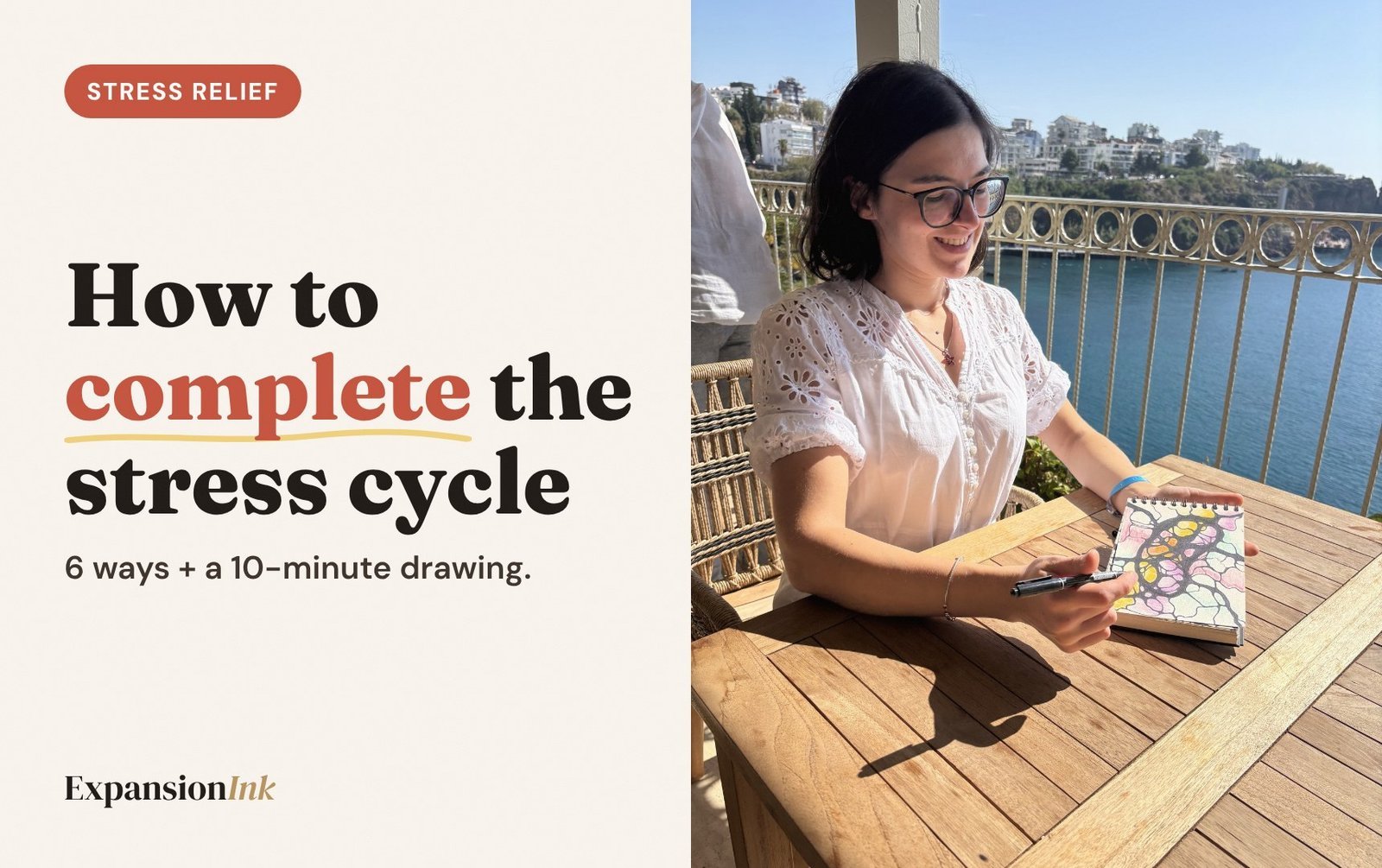
The meeting ended hours ago.
The email got answered.
The argument is over.
So why is your jaw still tight at 11pm?
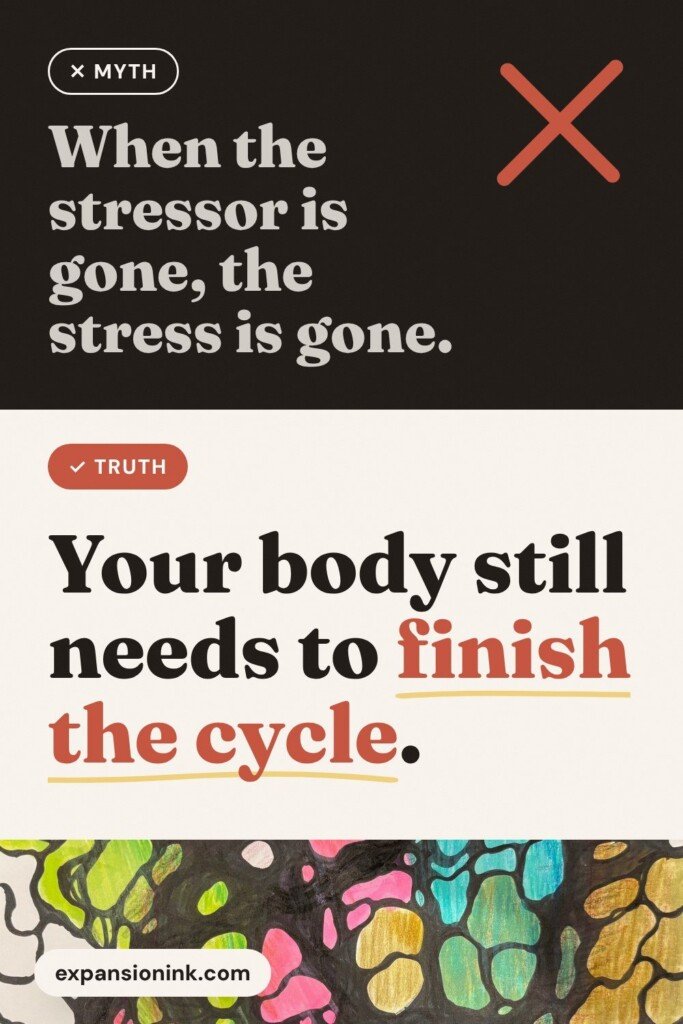
Because the problem ending and the stress ending are two different things.
Your body needs its own signal that you’re safe.
Until it gets one, the stress stays.
That’s what it means to complete the stress cycle.
Below I’ll show you what it looks like, the six ways that work, and a 10-minute drawing you can do at the kitchen table when a run just isn’t happening tonight.
✨ Not sure where your stress sits right now? Take the free Stress Quiz.
What “completing the stress cycle” actually means (and why your stress doesn’t end when the problem does)
The idea comes from the book Burnout: The Secret to Unlocking the Stress Cycle by Emily and Amelia Nagoski.
Brené Brown talked with the Nagoski sisters about it on her podcast, which is where a lot of people first heard the phrase.
Their key point is simple.
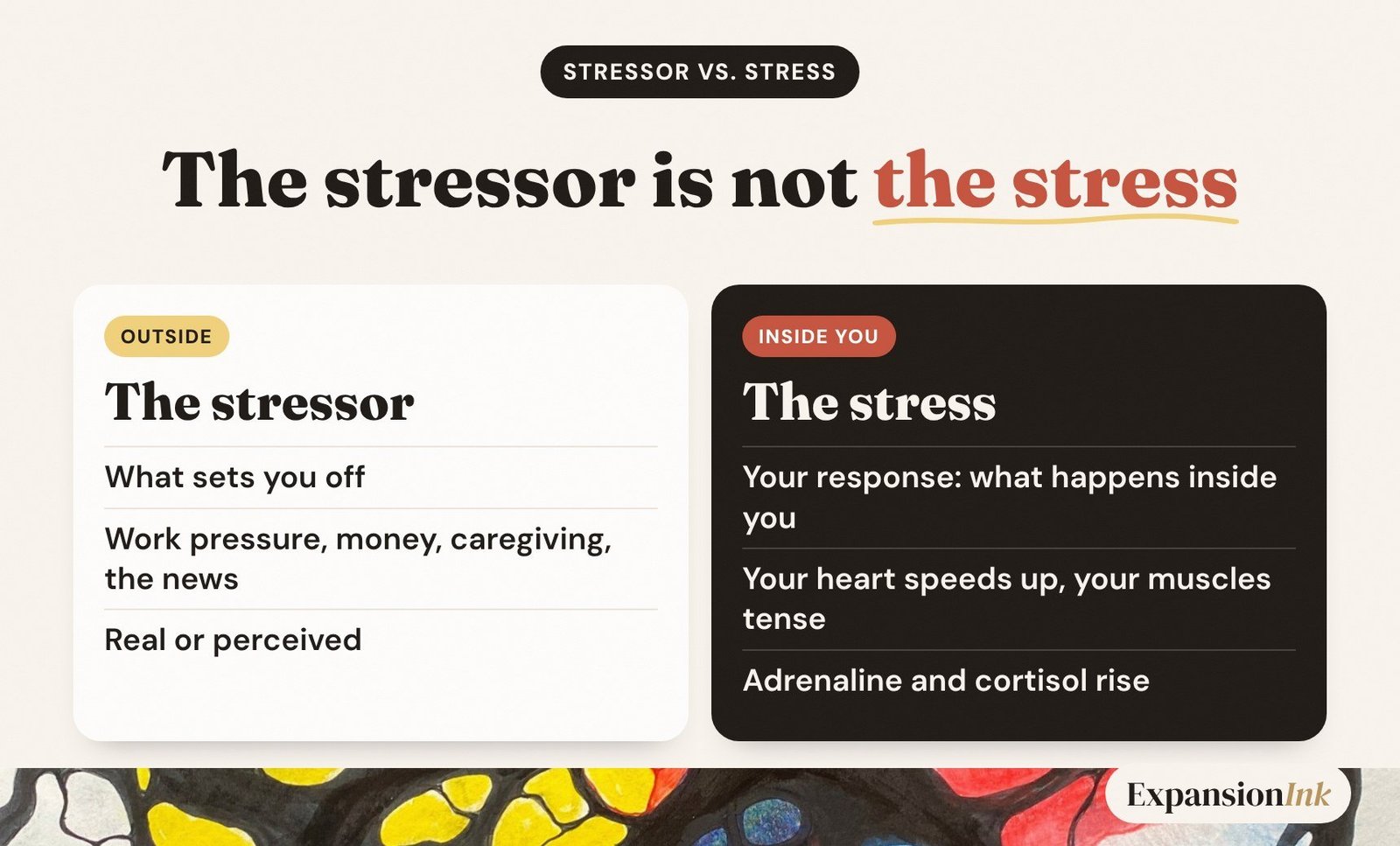
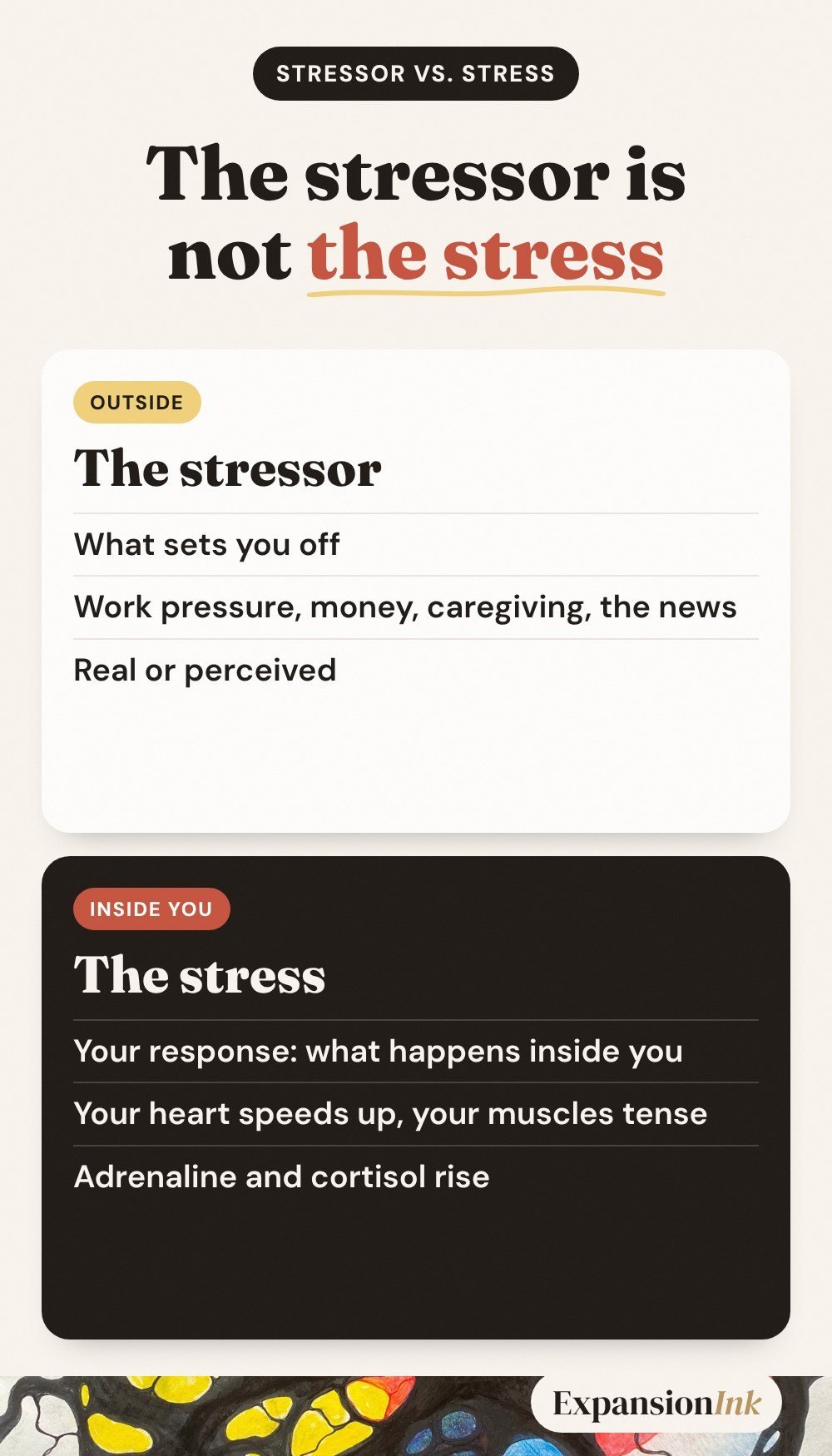
The stressor and the stress are not the same thing.
Stressor vs. stress
- A stressor is what sets you off. Work pressure, money, caregiving, a difficult conversation, the news. It can be real or perceived. It can come from outside, or from internal factors like the voice that says you’re behind.
- Stress is your response to stress: what happens inside you. Your heart speeds up. Your muscles tense. Hormones like adrenaline and cortisol rise. Your brain and body get ready to deal with potential threats.
For most of human history, the stress response had a clear ending.
You ran from the danger, you reached safety, your body calmed down. The cycle closed.
Modern stressors don’t work like that. You can’t outrun an inbox.
So you deal with the stressor (you reply, you fix it, you smile through the meeting), but your body never gets the message that it’s over.
The stress stays unresolved and piles up under the next stressor.
👉 So the answer is to give your body that missing ending.
Not by solving the problem, but by showing your brain and body, physically, that you made it and you’re safe now.
It’s a neurological and physiological shift, not a thinking exercise.
Signs your body is still stuck in the cycle
It’s easy to get stuck without noticing. See if this sounds familiar:
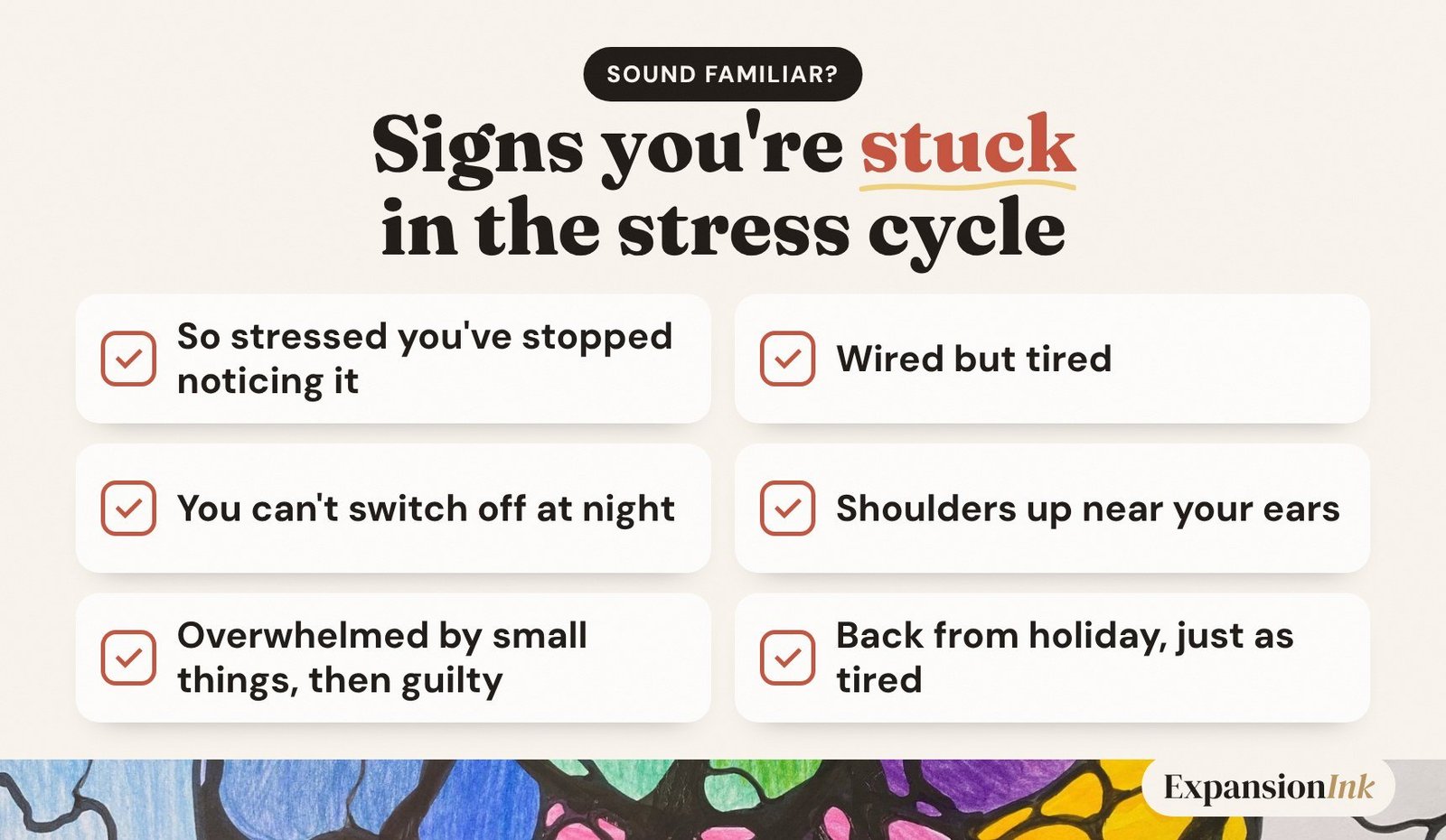
- You’re so stressed all the time that you’ve stopped noticing it
- You feel wired but tired: exhausted all day, wide awake the moment your head hits the pillow
- You can’t switch off at night, and your mind starts the next list
- Your shoulders live somewhere near your ears
- You feel overwhelmed by small things, snap, then feel guilty about it
- You take the holiday and come back just as tired
If you’ve ever asked yourself “why am I so stressed all the time?” when nothing big is wrong, this is often the answer.
It isn’t one stressful event. It’s dozens of small ones that never got closed.
Left long enough, that can lead to burnout and emotional exhaustion.
And for many women in their 40s and 50s, the load is heavier than it looks from outside. Work, aging parents, kids who still need you, a body that’s changing.
Modern life doesn’t leave much room to finish anything, least of all feelings of stress.
I know this one personally.
In 2021, stress was running my life. Headaches, tension, fatigue, broken sleep. The usual professional woman’s package nobody talks about.
I was handling everything. My body wasn’t.

Free stress quiz
Not sure how stuck you are?
Take the free Stress Quiz. It takes a few minutes and shows you where your stress sits right now.
Take the free Stress Quiz →6 proven ways to complete the stress cycle
The Nagoskis describe several ways to complete the stress response cycle. These are the six I come back to most.
👉 You don’t need all of them. You need one that fits your day.
1. Movement
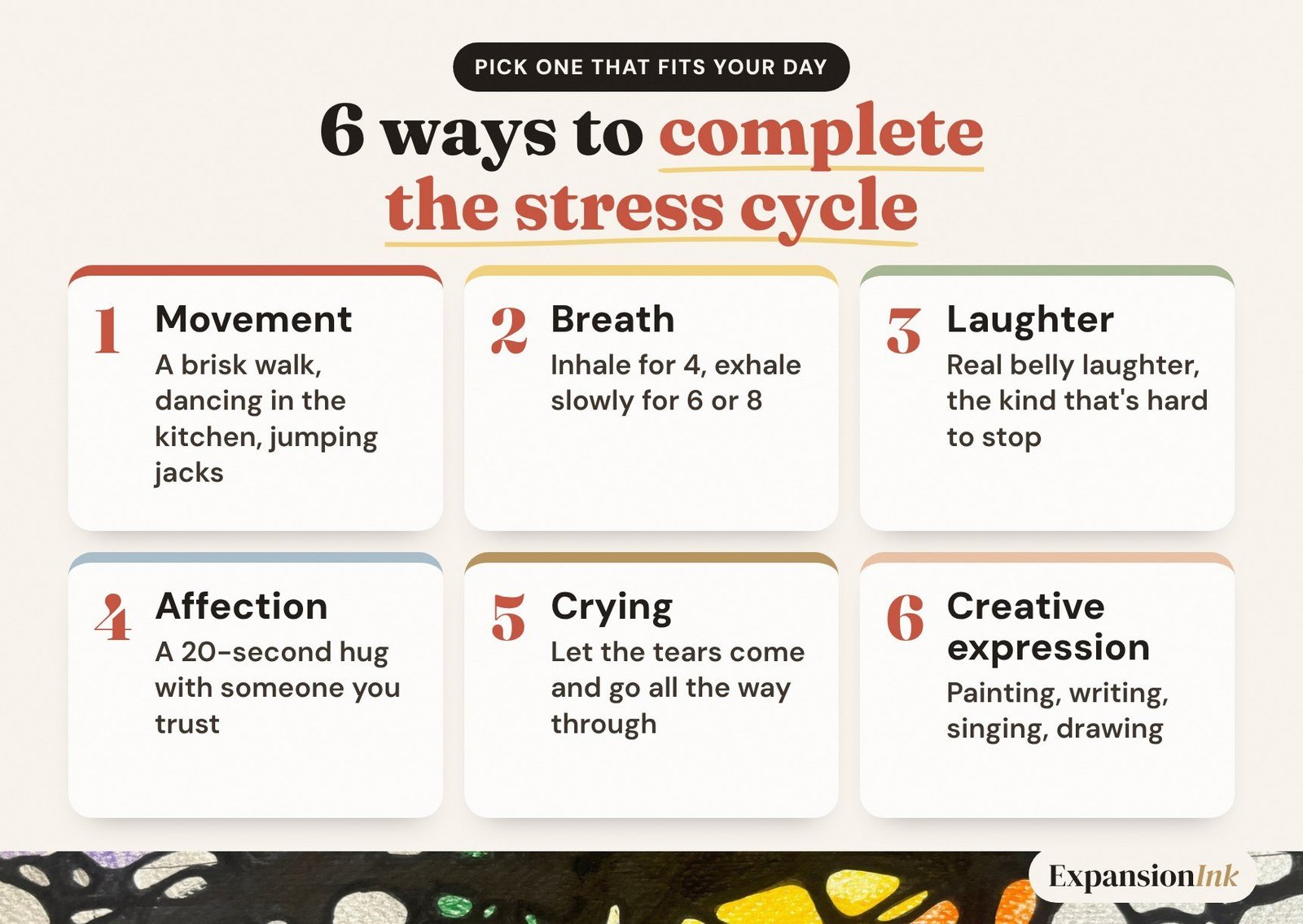
Physical activity is the most direct route. Your body got ready to run, so let it move.
A brisk walk, dancing in the kitchen, a minute of jumping jacks.
The point isn’t fitness. It’s showing your body the threat has passed.
2. Breath
Slow, deep breaths with a longer exhale help your body shift toward the parasympathetic nervous system, the “rest” side.
👉 Try it now: inhale for a count of four, exhale slowly for a count of six or eight. Repeat a few times.
3. Laughter
Real belly laughter, the kind that’s hard to stop.
Even remembering a time you laughed until you cried can help.
4. Affection and connection
A 20 second hug with someone you trust.
Yes, actually count the 20 seconds. It feels long, and that’s the point.
Holding a friend, a partner, a pet. Physical affection tells your body you’re among your people.
Smaller moments of social interaction count too: chatting with a neighbor, giving someone a compliment.
5. Crying
A good cry isn’t a breakdown.
Let the tears come and go all the way through.
Many people feel lighter afterward, as if something finally finished.
6. Creative expression
Painting, writing, singing, drawing.
Creative expression gives your feelings somewhere to go other than your shoulders.
This is the one that changed things for me, so let’s look at it more closely.
Why drawing works when the others don’t fit your day
Let’s be honest. You know movement helps.
But it’s 9pm, it’s raining, your knees hurt and the dishes are still in the sink.
Hugs need another person. Crying doesn’t happen on demand.
A drawing needs 10 minutes, paper and a pen.
You can do it at your desk, at the kitchen table, even in bed.

Here’s why it works, in plain words.
- It’s physical. Your hand moves in slow, steady lines, and that rhythm gives your body a calmer pace to follow. It’s a somatic practice: it works through the body, not just through thinking.
- It slows your attention down. You can’t draw a careful line and race through your to-do list at the same time. Your mind lands on the page, and that absorbed, unhurried focus is close to what people call a flow state.
- It makes stress visible. Once the tension is on paper, you can look at it instead of living inside it. That small distance is often enough to release the stress your body was holding.
- It has an ending. You start a drawing and you finish it. Your body gets a clear “done”, which is exactly what an incomplete cycle is missing.
👉 The method I teach is a simple structured drawing with a set sequence of steps.
You don’t need any experience to try the exercise below.
Try it now: a 10-minute stress-cycle drawing
You need plain white paper, a black marker or pen and two or three colored pencils.
No drawing experience needed.
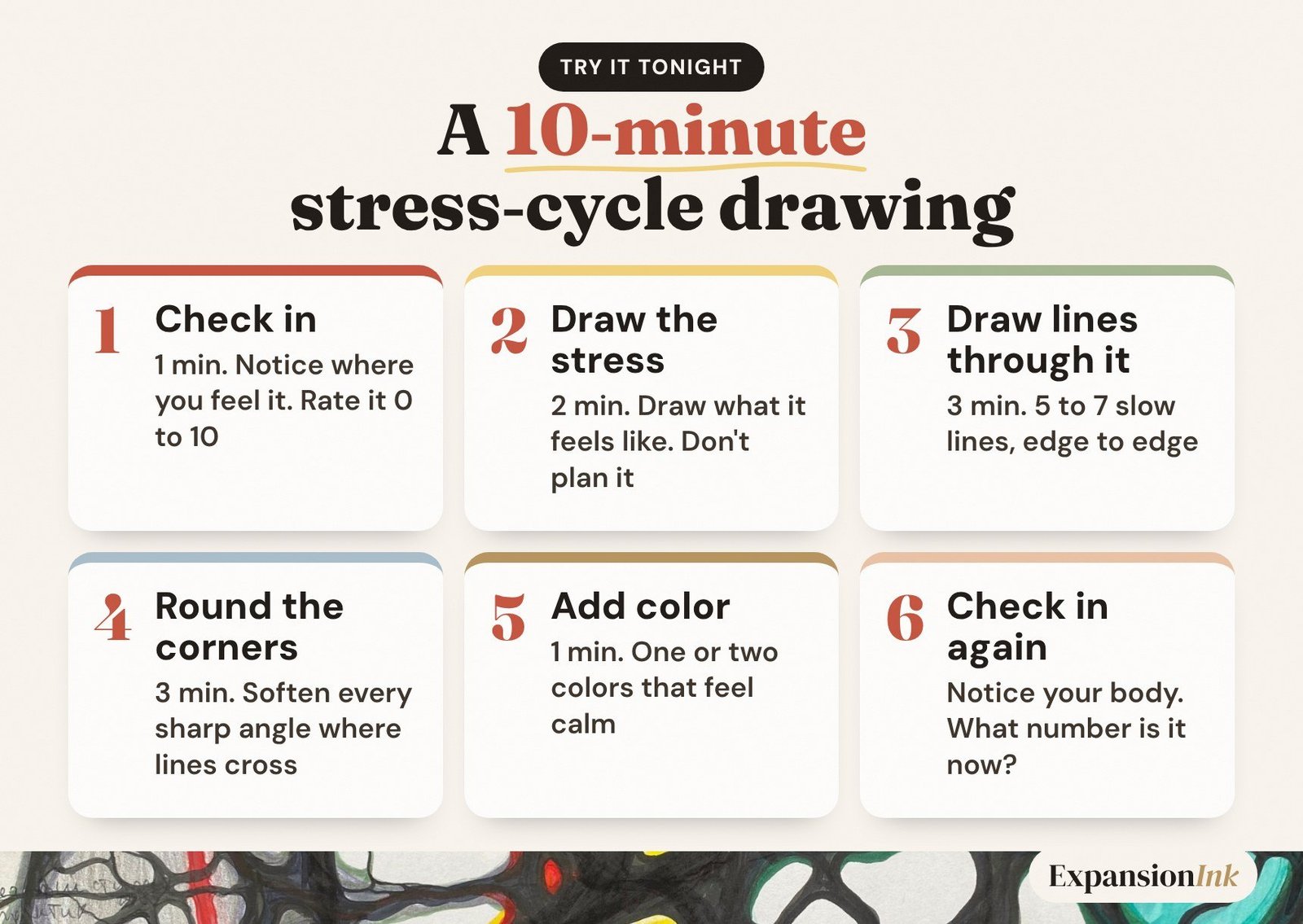
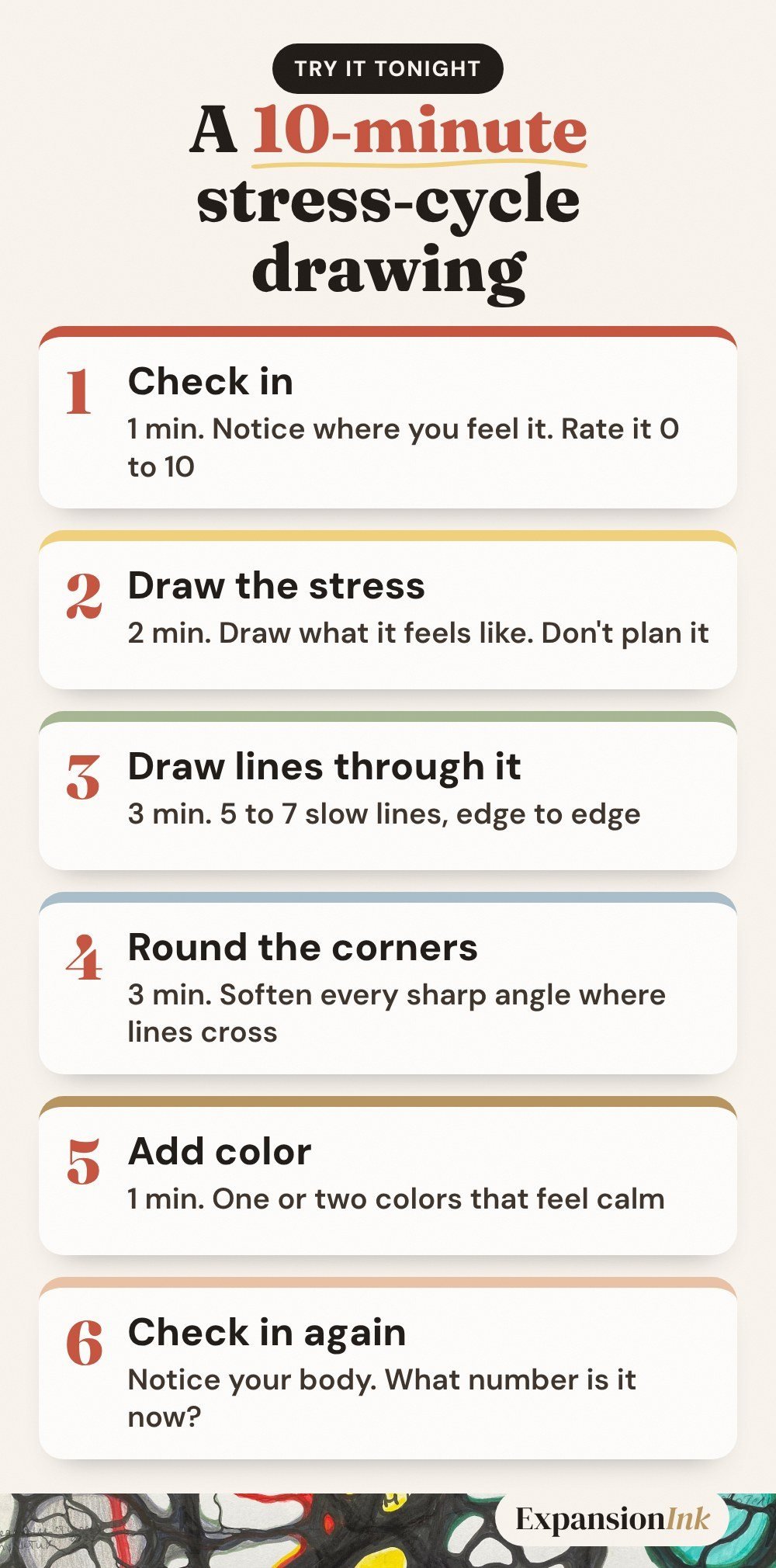
Step 1: Check in (1 minute)
Think of what’s sitting on you right now.
Notice where you feel it in your body.
Give it a number from 0 to 10.
Step 2: Draw the stress (2 minutes)
In the middle of the page, draw what that stress feels like. Don’t plan it.
Sharp, tight, tangled, heavy. Let your hand show it.
Step 3: Draw lines through it (3 minutes)
Now draw slow lines that start at one edge of the paper and leave at another, passing through and around your stress shape.
Let each line wander. Five to seven lines is plenty.
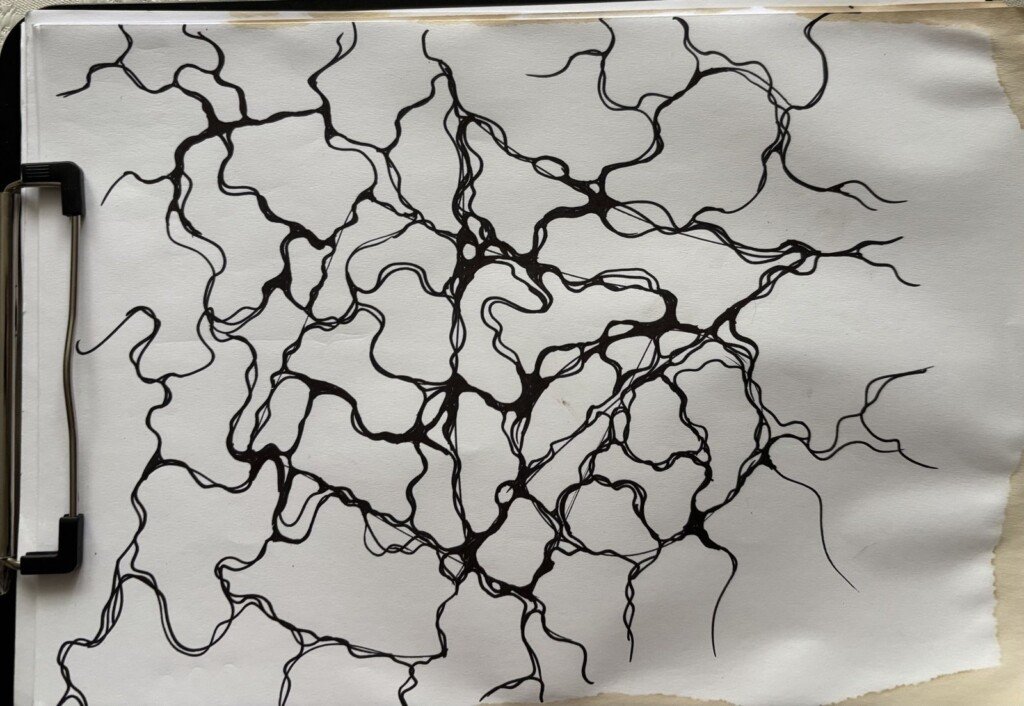
Step 4: Round the sharp corners (3 minutes)
Wherever lines cross and make a sharp angle, soften it with a small curve, so the corner looks rounded instead of pointed.
This is the slow part. It’s often where people notice their breathing change.
Step 5: Add color (1 minute)
Pick one or two colors that feel calm to you and fill a few of the shapes.
Step 6: Check in again
Look at the page. Notice your body.
What number is it now?
Beauty is part of this. But if you’re trying to control it from the first stroke, you’re in your head, not in the drawing.
Let it unfold before you judge it.
Want a stress cycle worksheet? Copy these six steps onto a card and keep it with your paper.
✨ And if you want to go further on your own, start Feel Lighter, my free mini course.
If you’d like me to guide you through the full version, working with the trigger, the reaction and the belief behind your stress, that’s what we do in the Break the Stress Cycle workshop.
It’s a recorded workshop of about 2.5 hours, you draw along with me at your own pace, and it’s $19.
How often to do it, and what changes after a week
Stress is cyclical. There will always be a next stressor.
👉 So think of this as daily care, like brushing your teeth, not a one-time fix.
A simple rhythm: one 10-minute drawing a day for seven days, at roughly the same time.
Evening works well if you can’t switch off at night.

What to watch for during that week:
- The number at the end of each drawing drops a little faster
- You catch tension earlier in the day, before it builds
- Falling asleep feels easier
Keep your drawings and look at them side by side at the end of the week.
When I look back at my old drawings and notes from those first months, I can see the intentions I set: more consistent sleep, movement, relaxation.
And I can see how those things quietly came to life.
Stress is practically non-existent for me now.
I also lost 25 kg along the way. Not as a goal, as a side effect of the internal shift.

Free mini course
Feel lighter in 3 days
Let go of the stress your body has been holding, with three short lessons and simple drawing practices. No drawing skill needed.
Start Feel Lighter free →When it keeps coming back: stress cycle vs. chronic stress
Regular stress completion helps you avoid burnout.
But it deals with the stress, not the stressor.
If the same tension returns every day, something underneath keeps it running.
Often it’s a pattern or a belief.
- “If I stop, it all falls apart.”
- “Everyone else’s needs come first.”
Beliefs like these keep your body on alert long after any single event.
That’s how everyday stress turns into chronic stress, and over time it wears on your mental and physical health.
You can work on those beliefs on paper too: here’s why drawing often works better than journaling for this.
✨ If that sounds like you, take the Stress Quiz. It shows you what kind of stress you’re carrying, so you know where to start.
Run a business? An incomplete stress cycle shows up as a revenue ceiling. I write about that in the upper limit problem.
FAQ
How long does it take to complete the stress cycle?
It varies. Sometimes five minutes of movement or a good cry is enough. Sometimes it takes longer. You’ll know by how your body feels: looser shoulders, slower breath, a quiet sense of “done.”
Can you complete the stress cycle at your desk?
Yes. Slow breathing and drawing both release stress sitting down. Keep a few sheets of paper and a marker in your drawer.
Can I complete it if the stressor is still there?
Yes, and that’s the point. You don’t have to wait for the problem to end. You complete the cycle for your body while you’re still dealing with the situation.
Do I need to be good at drawing?
Not at all. You draw lines and simple shapes, step by step. I’ve supported 1,000+ people with this work, and none of it requires talent.
Is this art therapy?
No. This is a coaching and personal development practice, not therapy or medical treatment. Drawing to calm anxiety in the moment is fine, but if you’re dealing with ongoing anxiety, depression or trauma, please work with a licensed professional.
Your next step
You don’t have to fix your whole life to feel better tonight.
You just need to give your body an ending.
👉 Get Break the Stress Cycle for $19 and draw your way out of the loop, at your own pace.
And if you’re ready to go further, The 6-Week Stress Reset takes this deeper: six weeks of guided drawing to release the stress your body has been holding, so you can switch off, sleep better and feel like yourself again.
Ready for the next step?
Go deeper with a workshop
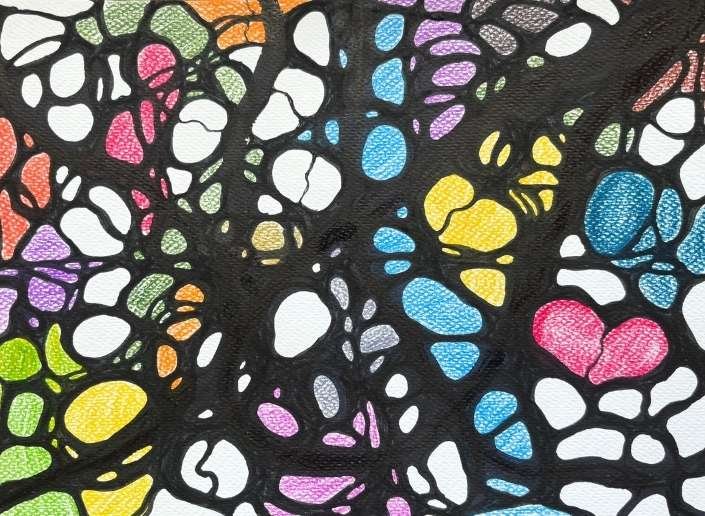 $19Recorded workshopBreak The Stress CycleFind what keeps your stress running and draw your way out of it.Explore the workshop →
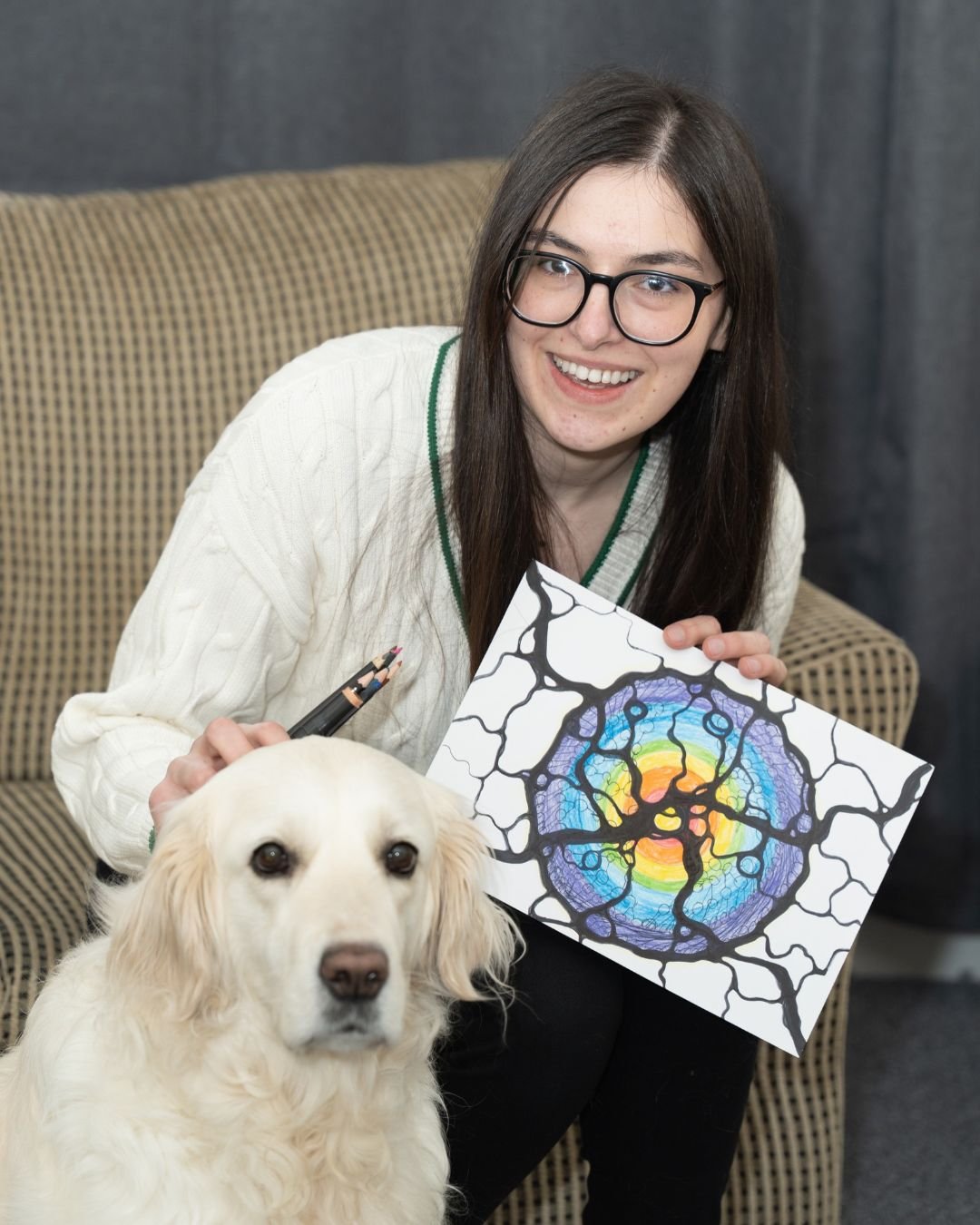 from $2676-week programThe 6-Week Stress ResetSix weeks of guided drawing to release the stress your body has been holding.Explore the program →
 $11Guided practiceGratitude PracticeFeel gratitude instead of just listing it.Explore the practice →
✨ Prefer to start free? Begin Feel Lighter, three short lessons to help your body let go.